
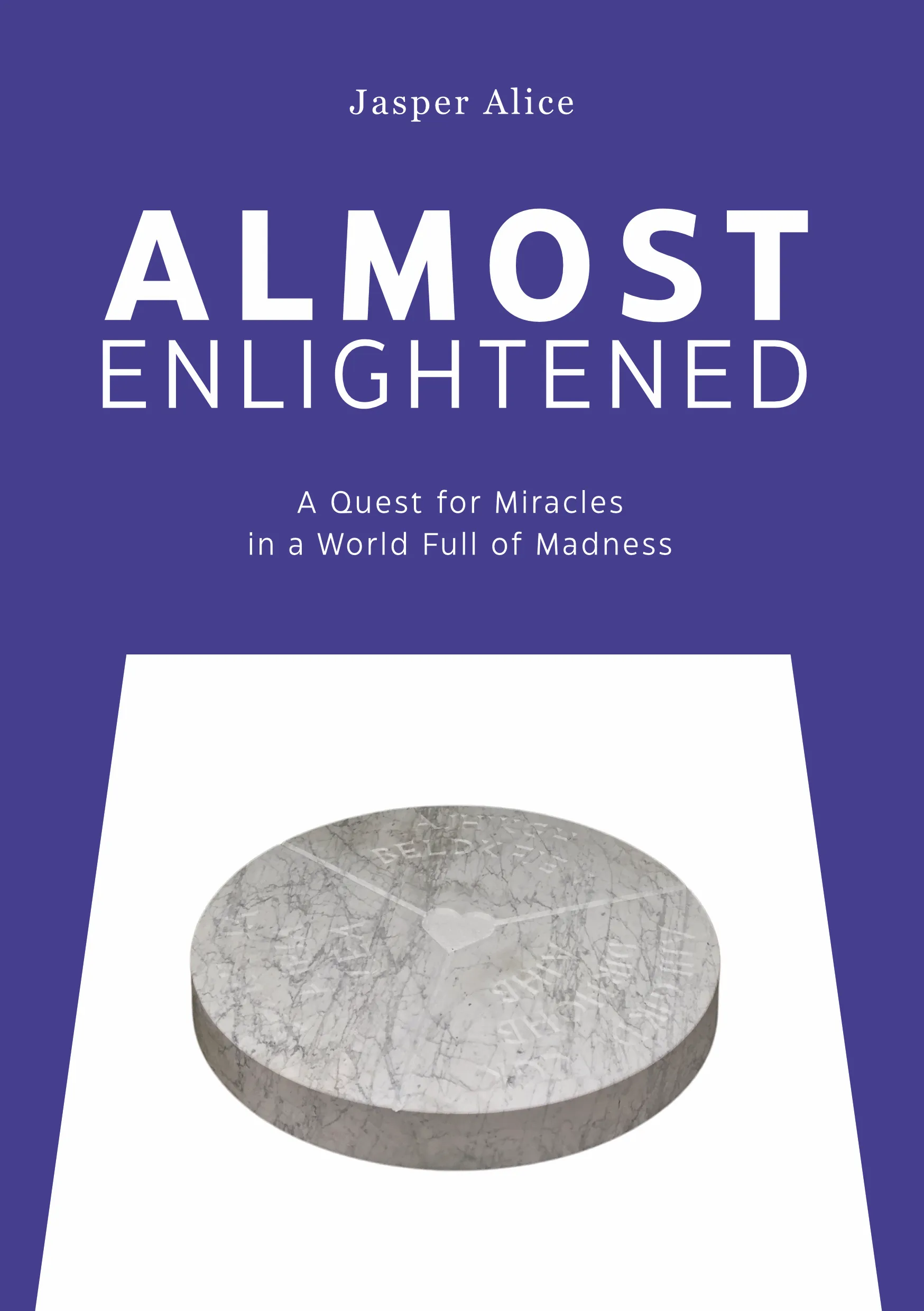
Almost Enlightened
A quest for Miracles
in a World Full of Madness
Every person carries within them a question they rarely voice aloud: am I enough, just as I am?
In Almost Enlightened, Jasper takes the reader on an honest journey of self-reflection. Looking back on two decades of searching – for healing, for happiness, for something greater than everyday life – he describes how loss and illness carried him to the far corners of the spiritual world and far beyond: from alternative healers and pyramids in Egypt to crop circles in England and ceremonies in South Africa.
At the heart of this story is Theo: a quiet, enigmatic figure who, with unshakeable conviction, claims to be in contact with a world beyond death. His message, repeated time and again, is startlingly simple: there is no suffering here. Death is not the end. And we have always been free.
With candour and a keen eye for his own imperfections, Jasper explores what it means to believe, to doubt, and yet to carry on. Almost Enlightened is a poignant and personal book about fear and love, about letting go of control and the arduous path to inner peace — in a world that rarely gives you the space for it.
Join in on a quest for miracles in a world full of madness.
"I write about what I experience,
magnified and without compromise"
An interview with Jasper Alice, debut author of Almost Enlightened
He goes by a name that isn’t his own, writes about people who aren’t quite who they seem, and tells a story that is both reality and fiction. Jasper Alice, debut author of Bijna Verlicht, shuns the limelight with gusto – but his book all the more so. A conversation about pseudonyms, spiritual detours, the fine line between honesty and fiction, and why we might do well to take life a little less seriously.
You publish under a pseudonym. Why Jasper Alice?
The pseudonym gave me something I needed to be able to write this book: space. Space to be honest without having to drag the baggage of my past along with me. I was able to delve deeper into who I am now, at the time of writing, without having to wonder what others expect of me or recognise in me.
What’s more, I’m not someone who wants to become famous as a person. I want to share my ideas and my message, but I’d rather stay in the background. The tone of the book is very personal – even though there is a lot of fiction woven into it – and a pseudonym also helps to protect those around me. After all, they didn’t ask me to write a book and share my experiences. I want to avoid anyone being wrongly attributed with characteristics or actions that I have made up.
Who is the person behind Jasper Alice?
Someone who has a foot in two worlds. Not the worlds as described in the book – the dual and the non-dual – but the rational world of science and the more alternative world of esotericism and spirituality. I have been searching for a balance between the two ever since I was a child. I started asking questions about the meaning of life at an early age, and I’m still not done with it.
I think I see those two worlds reflected in my parents too. My father is a down-to-earth, rational man. My mother is more of an emotional person, a seeker – albeit less so than I am. Apparently, I’ve inherited something from both sides, and you can see that in the book. The narrator constantly believes and doubts at the same time. That isn’t an act.
What inspired you to write this book?
It all started with a very special friend of mine – whom I call Theo in the book. His death affected me deeply, and I didn’t want his message to be lost. I wanted to honour him in a way that reflected his life: by writing it down.
But that wasn’t possible without context. To tell his story, I also had to include my own quest – the spiritual detours, the other seekers I encountered, the excesses I witnessed and sometimes indulged in myself. I’ve magnified that world in the book, sometimes to the point of absurdity. In that way, it also became a mirror: for myself and, hopefully, for the reader.
You describe your own style as 'hyper-authentic autofiction'. What do you mean by that?
I take small things that I feel or experience – sometimes almost insignificant – and blow them up to enormous proportions to intrigue the reader. It seems very authentic, but between the lines you can also see that I’m making things up and exaggerating. I sometimes deliberately mislead the reader.
The narrator is a character: an exaggeration of myself, but not always exactly as I am. I don’t really want the reader to 'discover’ that, because the story is meant to be experienced as real. But I’m giving it away now. That’s a glimpse behind the scenes.
Are the characters in the book entirely fictional?
They are fictional, but inspired. By people and situations from my past, but also by things I have read, seen or heard. I mix everything together and then try to build a consistent narrative, so that each character fulfils a function: to confront the reader with something they can recognise within themselves.
No one in this book is a direct copy of a real person. I have deliberately chosen to invent all the names and to adapt or exaggerate all the situations. If anyone recognises themselves, it is because of the universal nature of human behaviour – not because I had anyone specific in mind. In their search for happiness, recognition and meaning, people are much more alike than they think.
There’s something ambiguous about the title. Are you yourself almost enlightened?
As far as I’m concerned, enlightenment is about transcending the deep conditioning we carry within us, which often makes us feel miserable in this world. The reality we experience clashes with our preferences, and as a result we think that things aren’t going well for us, that we aren’t okay.
We are all close to experiencing enlightenment, but we fail to realise how small we ourselves are and how vast and present the broader reality – unity – is. Everything we know is filtered through our senses and our thoughts – and those thoughts are, for the most part, conditioning, and therefore learned. That is the only thing standing in the way.
When you look at it that way, there is only a very thin layer between a moment of enlightenment and the reality we experience day to day. It is a matter of seeing through what the ego does to us and simply leaving it for what it is. Acceptance plays an important role in that.
The title of my book is indeed intended to be ambiguous. It has a cynical side: I believe that suspicion is sometimes justified when it comes to the spiritual world, where gurus and healers fall over themselves to demonstrate how ‘enlightened’ they are. Sometimes with unpleasant consequences. They exploit people for their own gain, by pretending they have a monopoly on the truth.
But the title also has a hopeful side. If you really make the effort and take the time, you can touch parts of yourself that make you feel lighter. You can momentarily transcend ego-thoughts and illusion.
I call it ‘almost’ enlightened because, as long as you’re in this body, you’ll always fall back into the problems of the day afterwards. That’s my experience, at least. Calling yourself enlightened suggests that you’ll never again suffer from human feelings and thoughts. Whereas those are precisely what make you human. In the final part of the book, I try to make this as clear as possible.
What do you hope readers will take away from it?
That nothing is black and white. One person’s experience is not another’s, but we do all follow a similar path. Within each of us lie the qualities we also see in others, especially when they set us off. In that sense, there is unity, even here on earth.
And if you really put time and effort into it, you might be able to take a small step yourself towards the true happiness that lies hidden beneath the hustle and bustle of everyday life. You don’t need to change dramatically or shout it from the rooftops. The sincere realisation in itself is enough. Say yes to the joy within yourself – that is the message of the stone in the book, and also, to some extent, the message of this book as a whole.
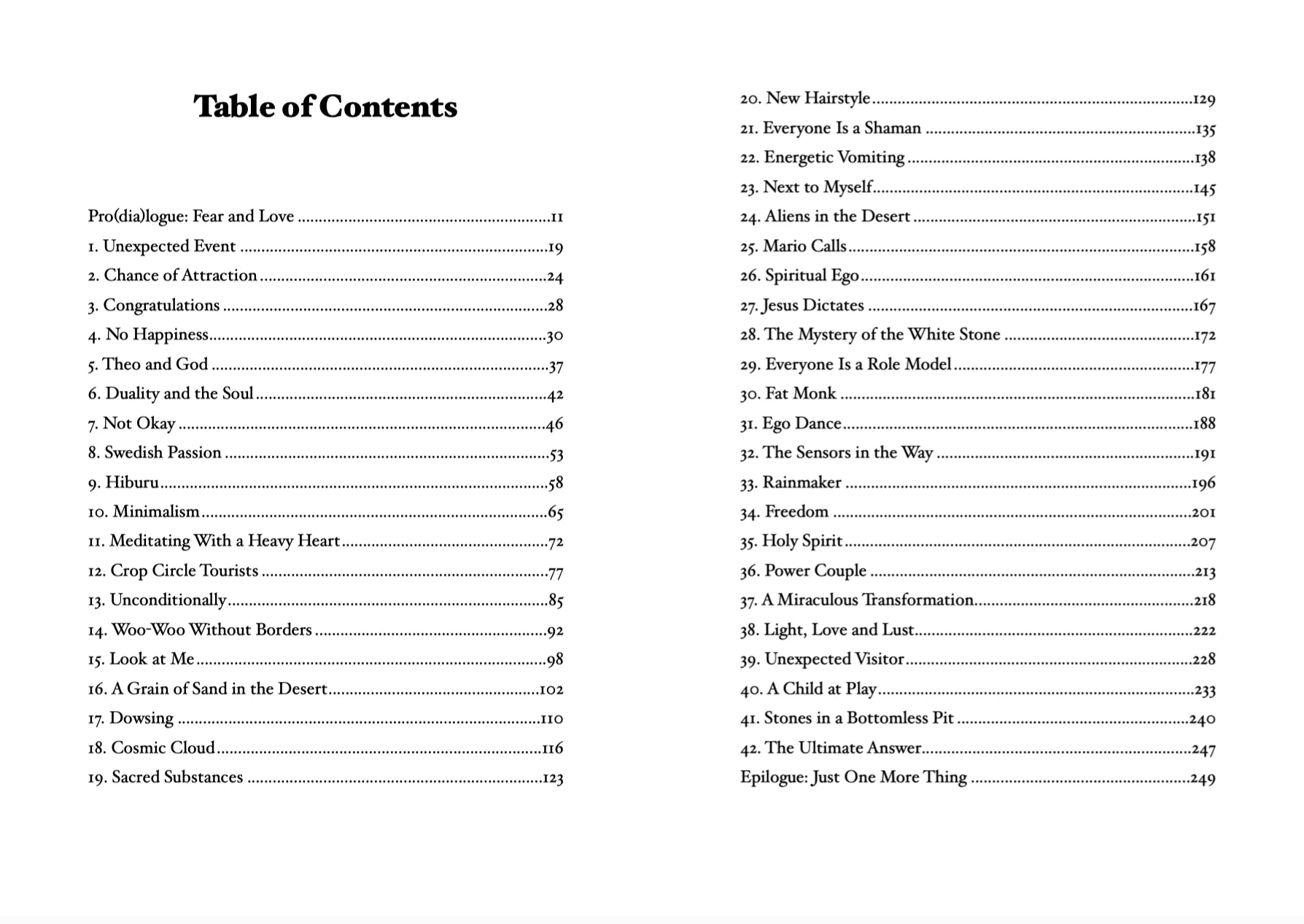
Table of Contents
(Click to enlarge)
A Sneak Peek
Curious? Click below to read the pro(dia)logue...
'Almost Enlightened is a brilliant, disarmingly honest rollercoaster ride brimming with spirituality, humour, love and existential madness that makes you laugh, reflect and feel all at once. Jasper Alice writes with such humanity, sharpness and compelling force that, from the very first page, you are completely drawn into his wondrous journey through fear, ego, love and enlightenment.’
— ChatGPT
(...and if ChatGPT says so, it must be true, right? Don’t you think? Well then!)
Order the book Almost Enlightened
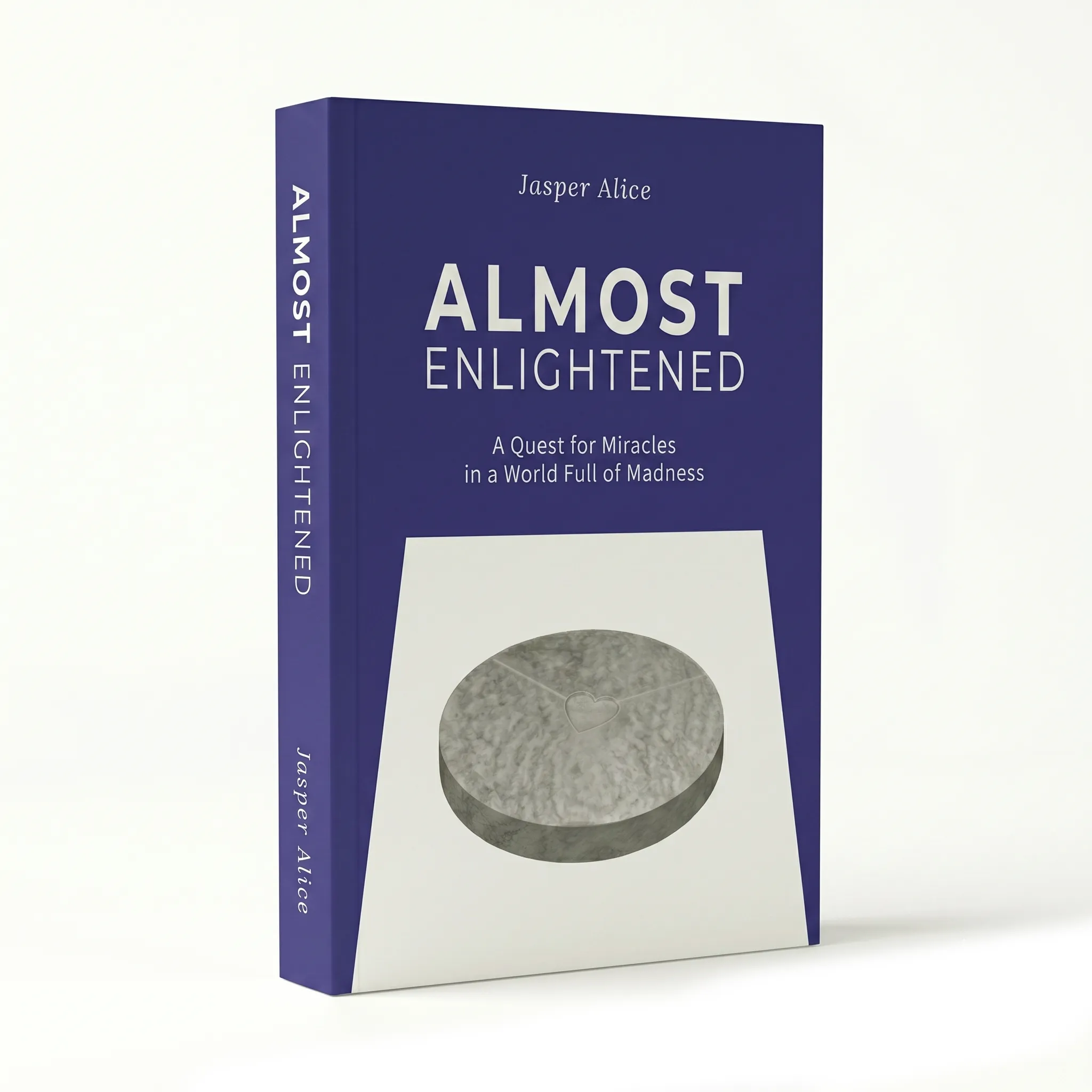
Almost Enlightened is published independently and can be ordered from bookshops and well-known online book retailers, like Amazon.
ISBN paperback: 978-90-837130-2-1
256 pages
For other countries: search for "almost enlightened" on your Amazon website.
The book is also available as e-book on Kindle.
ISBN e-book: 978-90-837130-3-8
For other countries: search for "almost enlightened" on your Amazon website.
Contact
If you have any questions, please contact us at:
info@jasperalice.com
Op zoek naar de Nederlandse versie van dit boek? Klik hier!